
Nine in Ten Americans Paid for Play and Only 14% Found It Through a Brand Email
The Harris Poll surveyed 2,158 American adults about what it calls kidulting, and the answer for a commerce operator is less about blind boxes than about discovery, because the buyers are there and the brand channels are not where those buyers look.
What does an adult who builds model kits on a Tuesday night have to do with a merchant’s acquisition plan? The Harris Poll measured it in a report embargoed until October 21, and the measurement is 89% of American adults who spent money on playful products or experiences for themselves over the survey’s 12-month window. Of those adults, 65% spent $100 or more in at least one category and 13% spent $500 or more. The survey ran online from June 25 to 27, 2026, with a nationally representative sample of 2,158 adults, and the report defines kidulting as adults buying or taking part in playful products, hobbies or experiences associated with childhood, from collecting toys and building models to blind boxes, board games and themed restaurants.
Who Is Spending and on What
The money skews young, with a generational spread wider than the headline rate suggests. Among Gen Z, 95% spent something on play over that window and 80% spent $100 or more, against 77% and 35% for Boomers. Across the eight product types the survey tracked, Gen Z and Millennials out-bought Gen X and Boomers by 25 to 43 points, with board games and puzzles at 71% for the younger group against 46%, and plushies and dolls at 63% against 20%.
Building and assembly kits show the widest spending gap of any category, with 46% of Gen Z and Millennials spending $100 or more in the past year against 20% of the older generations. Trading cards, collectible figures, board games and craft activities follow in that order.
The experiences side runs the same direction. Among Gen Z, 83% took part in physical play, 79% visited themed restaurants or bars, 76% went to an art or crafting session and 70% used a social gaming space in the past year, each 20 to 28 points above the national rate.
Why They Buy and What Stops Them
Among the respondents who took part in play, 50% said a playful purchase helps them relax, 46% said it is affordable or easy to justify, and 41% said it reminds them of something they loved growing up. Social sharing came last among the reasons, and 17% picked shareability as a reason to buy.
Cost is the main brake. Asked what stops them from spending more, 32% said the products feel too expensive, 25% worried it is not a responsible use of money and 24% said they lack the time. Embarrassment about liking these things as an adult came in at 12%, even though 49% said they sometimes feel judged for enjoying things considered childish. A full 26% said nothing prevents them from spending more.
Libby Rodney, chief strategy officer at The Harris Poll, framed the spending and the self-care finding together in the statement that accompanied the report.
“Two-thirds of Gen Z and millennials now call kidulting one of their main forms of self-care. That’s not a punchline. That’s a generational shift in how young Americans are managing their mental health, and they’re backing it up with real spending. Eight in 10 spent over $100 in the past year on play, and 16% spent more than $500. Yet 81% of Gen Z feel brands still underestimate how much adults want playful experiences designed for them. There’s a massive gap between what young consumers are asking for and what the market is delivering. The brands that close it first will own one of the most emotionally resonant spaces in consumer culture.”
The report also finds that adults do not want a child as cover. Of the respondents, 86% agreed that adults without children are as entitled to playful products and experiences as families are, and 85% agreed that adults do not need children as an excuse, with Boomers at 90% on both.
Where the Buyers Look, and Where Brands Are Not
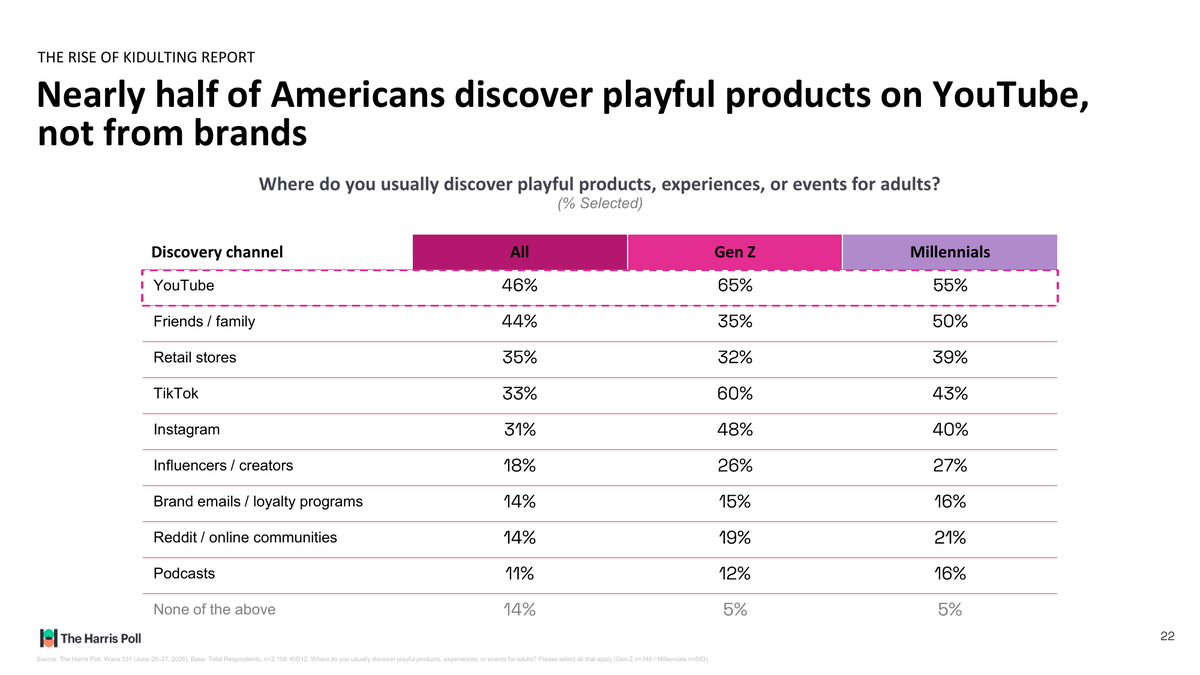
The discovery table is the part of the report a commerce team can act on. Asked where adults usually discover playful products, experiences or events made for them, 46% of respondents said YouTube, 44% said friends and family, 35% said retail stores, 33% said TikTok and 31% said Instagram. Among Gen Z, YouTube reaches 65% and TikTok 60%.
Brand emails and loyalty programs reach 14%, tied with Reddit and online communities, and ahead of podcasts at 11%. For a category where 89% of adults are already spending, the owned channels most merchants invest in rank near the bottom of how those adults find the product.
The report pairs that gap with a demand signal. Of the respondents, 77% said most brands underestimate how much adults want playful experiences designed for them, 73% said brands too often assume playful experiences are only for families with children, and 67% said they are looking for brands, products and experiences that make everyday life feel lighter. When asked which brand types have the most permission to make play for adults, respondents named toy and collectible brands at 50%, entertainment and streaming brands at 47% and gaming brands at 46%, with retailers at 27% and fashion at 26%.
What Adults Want Brands to Make
Adult-only nights at theme parks, museums and zoos top the wish list at 62%, followed by nostalgic movie or cartoon marathons in theaters or bars at 60%, adult-focused craft kits and building sets tied to childhood brands at 59%, and themed travel packages or hotel stays at 57%. Gen Z and Millennials run 6 to 12 points higher on each.
Asked what makes a playful product feel designed for adults rather than kids, 42% named adult-only access or events, 39% named nostalgic references adults understand, 37% named food, drinks or nightlife elements and 35% named better quality materials. A higher price point or premium feel came in at 22%, so price ranks near the bottom as an adult cue while price ranks first as a barrier.
Nostalgia is the lever the report calls most reliable. Of the respondents, 80% said they feel more emotionally connected to a brand that taps into their childhood memories, and 79% appreciate when brands create adult-focused versions of things they loved as a kid, with Millennials at 86% and 87% on the two statements.
Tim Osiecki, Director of Thought Leadership and Trends at The Harris Poll, put the generational piece in plainer terms in a comment sent to Talk Commerce.
“There’s also a generational shift happening. Younger adults are much less interested in performing a traditional version of adulthood just because that’s what previous generations were expected to do. They’re more comfortable saying, ‘I like this, it makes me happy, and I don’t need to justify it.’ That can mean buying a LEGO set, collecting plush toys, going to Disney without kids, dressing up for a movie premiere or spending money on an experience that reconnects them with something they loved growing up.
So in many ways, kidulting is less about escaping adulthood than it is about making adulthood feel more livable. It’s adults reclaiming play as a legitimate form of self-expression, stress relief and connection, rejecting the idea that maturity has to come at the expense of joy.”
What This Means for Commerce
A merchant selling into this category has a buyer who is already spending, says price is the main reason for not spending more, and finds the product on YouTube and TikTok rather than in the brand’s email list. Two numbers set the brief. The first is the 14% who discover through brand emails or loyalty programs, which says the list is a retention channel here and not a discovery one. The second is the 42% who say adult-only access is what marks a product as made for them, which is a merchandising and event decision before it is a marketing one.
The figures are The Harris Poll’s own, from a single online survey wave, and the report measures what respondents say they spent and want rather than transaction data. The sample sizes for the generational splits range from 346 Gen Z respondents to 693 Millennials, which is enough to read the direction of the gaps and not enough to read a single point of difference. The full report, The Rise of Kidulting, is published by The Harris Poll Thought Leadership Practice, dated October 2026.