
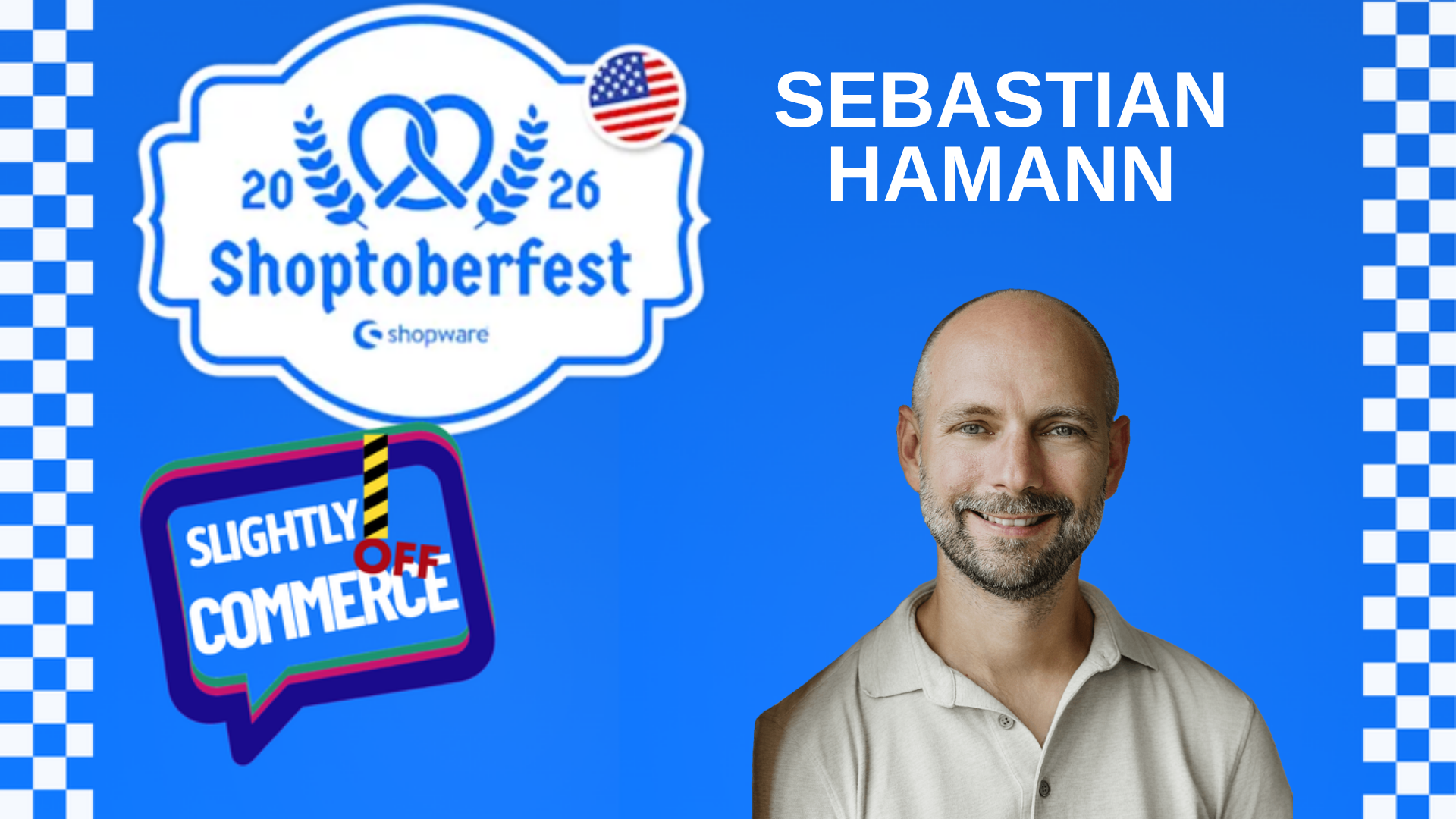
Live from Shoptoberfest with Sebastian Hamann from Shopware
Scott Ohsman of Always Off Brand and I spent September 15 at Shoptoberfest in Nashville, presented by Shopware, and we recorded our Slightly Off Commerce collaboration there. It was the third Shoptoberfest, and the guest I had waited three years to get across the table was Sebastian Hamann, co-founder and CEO of Shopware. I started where the company started, with a teenager in a German village.
A Village Called Schöppingen
Sebastian founded Shopware with his brother, and both of them were still in their teens.
“My brother was sixteen years old, I was fifteen years old,” he says.
The brothers grew up in Schöppingen, a village of eight thousand people, and Sebastian describes the two of them as the computer nerds of the village. I asked whether he ever took a job at the local grocery store. He did small things for pocket money, and the business took over from there. I also asked what the word for shopping is in German, and the answer explains part of the name, because Einkaufen did not sound cool enough for a software company.
The name has a second half to the story that Sebastian says few people know.
“Before shopware we called it shop IT. And this name sucks,” he says.
The brothers landed on Shopware, and Sebastian calls the decision behind the name a smart one.
“We decided to name the company like the product,” he says.
He points to the early 2000s, when search and organic traffic were taking shape, and says one name for both the company and the product kept everything straightforward. His first customer was his uncle, who ran a small office shop in the village and asked what the brothers thought about selling items online. No standard software on the market was good enough for two teenagers to want to build on, so the brothers wrote software for their own shop.
Giving the Software Away
Shopware paid its early bills with customer projects. Sebastian and his brother were product founders, so they started a partner program and let agencies do the customization while they worked on the core. Then came the decision to open the source.
“Giving this away for free, an open source version, is also a kind of risk,” he says.
Shopware already had a commercial licensing model running, so giving a version away carried a real cost. The result showed up in 2010.
“I remember where I was sitting in front of the browser and was pressing the F five key for you know, refreshing the statistics and I was like, Wow, come on, is it really to the truth?” he says.
He remembers watching the downloads climb toward one hundred thousand, and he is careful to say that downloads are not live shops. What he saw was people building on his software and fixing problems in their own industries, which he describes as a snowball rolling down a hill.
Design Against Engineering
I asked how he and his brother split the work. Sebastian took design, the shop administration, and the front end, and his brother engineered it.
“It was always this constant level of friction that led to release, release, release,” he says.
Sebastian says nothing was good enough for him to ship, and his brother thought everything was too slow. Scott has a friend who lives with the same tension, and I told him about the developer who promises a small task and delivers it long after the promise. Sebastian says he once freaked out because his brother released something without telling him. He learned over time to keep the customer in view ahead of his own perfectionism.
No University, No Safety Net
I asked whether he ever went to university. He did not. Sebastian and his brother started Shopware at fifteen, and people advised the two of them to go anyway.
“If you do something where you’re passionate about it, right? Then you oversee risks,” he says.
He does not have rich parents or a degree to fall back on, and he says that passion outweighed the fear of failing. Scott asked how the family took it, and Sebastian gave the answer any founder will recognize.
“It was, you know, it was really hard to explain to my grandma what we do. Something with computer,” he says.
Hungry and Humble
Scott asked whether he is still hungry. Sebastian says the company runs on three values, open, authentic, and visionary, and he applies them to what AI is doing to commerce.
“I think it’s the best time to be in this industry,” he says.
His brother was experimenting with GPTs early, and Sebastian says it arrived for him when he saw grandparents using it. I pointed out that Shopware put AI into the core of the platform ahead of most, and he credits the product founders’ habit of building first.
“We did not ask anyone, we just made it,” he says.
He says the same habit produced spatial commerce work that did not find wide adoption, and he is fine with that.
“And even if not, then we have tried it,” he says.
Where he points it next is clear.
“I’m hungry. I’m hungry to rethink commerce for agents and for humans,” he says.
Learning the US Market
Scott asked how Shopware thinks about the US, and Sebastian dated the decision to 2021 and 2022, when he and his brother concluded that Shopware would never reach the US market if the company did not go then. The first outside investment in Shopware went toward the US business, because they needed people on the ground here.
The first plan was to repeat the European playbook.
“We were thinking, okay, let’s do the same playbook as in Europe, as it worked out, but it didn’t work out, right?” he says.
Scott told him he has worked with a hundred European companies who tried the same thing, and Sebastian answered that a call would have saved him a great deal of money. He says the Adobe acquisition of Magento had moved thousands of Magento customers to Shopware in Europe, so the move felt natural, and then he ran into a difference.
“We just recognized that customers stay longer with their Magento’s tech stack than we expected,” he says.
The marketing had to change too, because Shopify, Salesforce, and others crowd the space. He describes Shoptoberfest as a little more guerrilla, and he says the company narrowed its focus.
“We laser focus more on mid market, also B2B, on complex commerce things, specific industries, regulated industries,” he says.
What a Community Looks Like
Scott and I both noticed how far the event has come. The first Shoptoberfest was small, and the 2026 Shoptoberfest filled a floor with hundreds of people. I told Sebastian the partner day was professional without feeling like a sales pitch, and he pointed to the stage as the reason.
“People sharing in an honest way their issues with each other, they learn from each other,” he says.
Sebastian was in Nashville for the first time, and he had a simple answer for what he likes about the city.
“Wherever you go, there’s live music,” he says.
Watch the Episode
Sebastian Hamann is co-founder and CEO of Shopware. This episode was recorded at Shoptoberfest 2026 in Nashville with Scott Ohsman of Always Off Brand.
The B2B Commerce Trends and Opportunities Report, written and researched by Content Cucumber and presented by Shopware, is free at contentcucumber.com. For more at-event interviews, visit talk-commerce.com/events.