
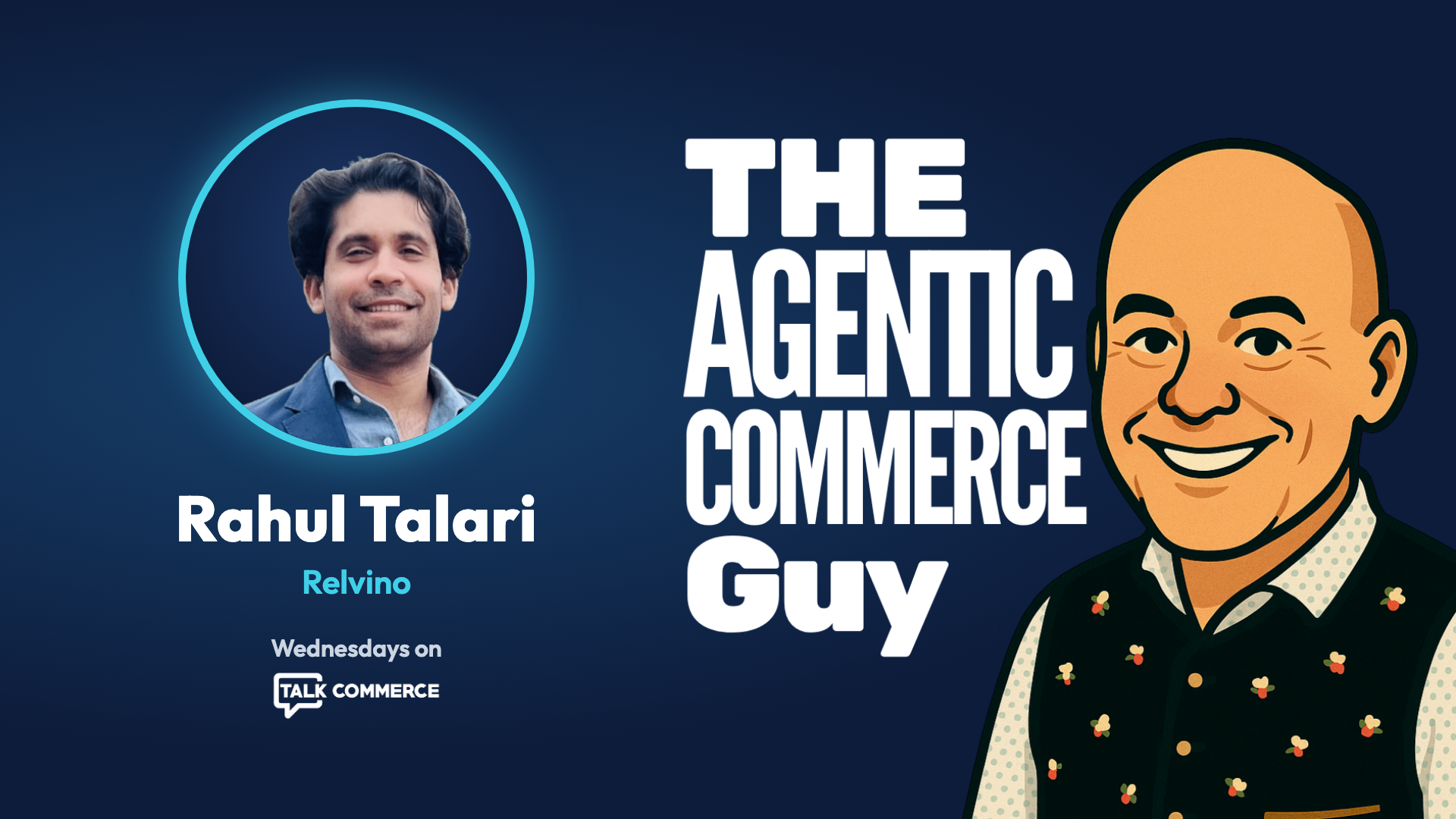
Email Marketing in Agentic Commerce with Rahul Talari of Relvino
Watch the Episode
The Agentic Commerce Guy is a new short segment of Talk Commerce. I sit down with one guest for about ten minutes on one agentic commerce topic, and it comes out on Wednesdays, the same day my Agentic Commerce Guy newsletter goes out on LinkedIn. Subscribe to the newsletter at linkedin.com/newsletters/7343682760978460672.
Rahul Talari is co-founder and CEO of Relvino, and before Relvino he was an ML engineer at CoreWeave, the AI cloud he describes as the one behind OpenAI, Meta and Nvidia. His day now is spent with brands, helping them automate their marketing with Relvino in place of the rule-based tools they have used for years. We sat down for a short Agentic Commerce segment of Talk Commerce, and I asked him where agents go wrong in email and where they go right.
Spray and Pray
Rahul started with what is wrong. A shopper adds to cart and leaves, the brand sends an email two hours later and an SMS ten hours later, and the timing comes from a rule somebody set by hand.
“These signals that you’re capturing are not actually based off of user behavior. They’re based off of assumptions based on market research as to when someone would come back and shop on your website. This is what is called the spray and pray approach,” he says.
His alternative is to understand the one person on the other end. He used me as the example, Brent as a shopper, in place of a cohort of people who look like me on paper.
“We’re not spraying and praying a thousand emails to a thousand shoppers who’ve added to cart abandoned. We’re only sending 50 emails,” he says.
One Agent per Shopper
Relvino drops the flows and the segments. Each shopper gets a marketing agent, built from how they click, browse, abandon or convert on the site, how they open and buy through email and SMS, and what the CRM knows about them.
“So we don’t have flows, no more segments. Every single shopper has their own marketing agent,” he says.
The numbers Rahul shared for Relvino’s brands are 80% fewer sends than the incumbents, a two to six times revenue lift for brands doing $100 million to $500 million, open rates of 35% against a 26.6% industry average, and $7.64 in revenue per email against $1.07. He also flips the usual order, starting with engagement and retention on the site and in the inbox, and moving to discovery on social and ads after that.
The Brand Keeps the Guardrails
I closed by asking about AI slop, and whether a message written by an agent ends up sounding like a bot. Rahul’s answer is a check that sits outside the AI. Relvino runs every AI-written message through a QA layer written as plain software, scores it against the brand’s global and campaign guardrails, and sends it back through the loop when it fails.
“We set global guardrails for your brand, local guardrails for your campaigns and flows, and we strictly adhere to these guardrails based on a software layer we’ve written that’s QA-based and non-AI,” he says.
The tone, the voice, the strategy and the products stay in the brand’s hands. What the agent takes over is the volume and the timing.
Rahul Talari is co-founder and CEO of Relvino. You can find the company at relvino.com and on LinkedIn at linkedin.com/company/relvino, and Rahul at linkedin.com/in/rahul-talari-65155176.